
NewsDetails
Unveiling the Manufacturing Process of Welded Mesh: From Material Selection to Welding
author:Anyaochen time:2025-07-20 20:38:03 Click:124
The production process of welded mesh includes six core steps: material selection, drawing, welding, adjustment, surface treatment, and inspection and packaging. The production process is rigorous and the technical requirements are high, as follows:
1、 Material selection: Strictly control the quality of raw materials
The raw material of welded mesh is usually steel wire or iron wire, mainly low-carbon steel wire, due to its excellent welding and mechanical properties. When selecting materials, strict inspection of the raw materials is required to confirm that the wire diameter, material composition, and surface quality meet the standards. For example, the commonly used galvanized iron wire diameter range is 0.5mm to 3mm, and the deviation needs to be controlled within ± 0.05mm to protect the welding strength and mesh accuracy.
2、 Drawing: Careful control of wire diameter and shape
The qualified raw materials will be subjected to cold drawing processing through drawing equipment, gradually reducing the diameter to the required specifications. This process requires accurate control of wire drawing speed and tension to avoid wire diameter deformation or breakage. For example, when making a 0.8mm wire diameter welded mesh, it is necessary to confirm the uniformity of the wire diameter through multiple drawing processes, with a deviation not exceeding ± 0.02mm.
3、 Welding: Core process confirms structural stability
Welding is a crucial step in the production of welded mesh, and resistance spot welding technology is commonly used. The principle is:
Equipment debugging: Set welding current, voltage, and time parameters based on wire diameter and mesh size. For example, when welding a 12.7mm × 12.7mm mesh and 0.8mm wire diameter welded mesh, the current should be controlled above 5000A, and the weld penetration should be 1/3 to 1/2 of the wire diameter.
Welding process: Apply pressure to the intersection point through electrodes, use the resistance heat generated by the current to melt the metal, and form a solid welding point. Excellent solder joints should be full and free of virtual soldering, and the tensile strength of a single solder joint should be above 100N to confirm the overall strength of the mesh.
Welding methods: In addition to resistance spot welding, flash welding, arc welding, or gas pressure welding can also be used, but resistance spot welding has become the mainstream choice in building insulation engineering due to its good efficiency and stable quality.
4、 Adjustment and Cutting: Protecting Dimensional Accuracy and Appearance
The welded mesh needs to be shaped by adjusting the equipment to eliminate deformation caused by welding stress. At the same time, cut and trim the irregular edges to confirm that the mesh size deviation is within ± 1mm, the mesh width deviation is ± 5cm, and the length deviation is ± 10cm, in order to meet the installation and splicing requirements. For example, hot-dip galvanized welded mesh is used for building exterior wall insulation, with mesh sizes of 12.7mm × 12.7mm or 19.05mm × 19.05mm, and strict control of dimensional accuracy is required.
5、 Surface treatment: Improve corrosion resistance (based on actual reports) performance
Surface treatment is a key step in extending the service life of welded wire mesh, and commonly used methods include:
Hot dip galvanizing: Immerse the mesh into molten zinc solution to form a zinc layer with a thickness of 45 μ m or more. The anti-corrosion (based on actual reports) period can reach more than 10 years, suitable for humid or corrosive environments.
Electrogalvanizing: By electrolytically depositing a zinc layer with a thickness of about 5-15 μ m, it has a lower cost but slightly weaker anti-corrosion performance (based on actual reports), and is commonly used in indoor dry environments.
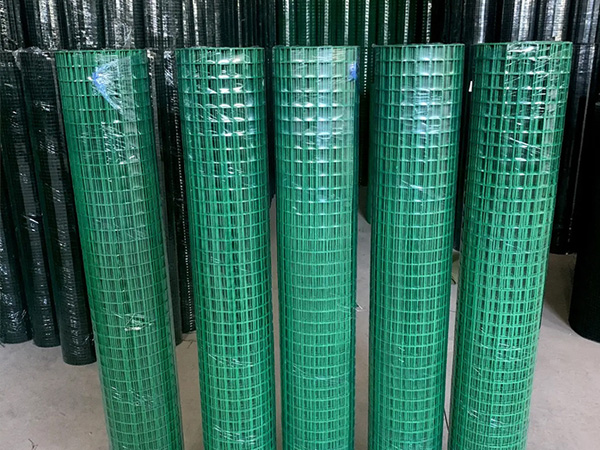
PVC plastic coating: Coating the surface of the mesh with a PVC plastic layer, which has both anti-corrosion (based on actual reports) and decorative functions. The color can be selected from dark green, grass blue, etc., suitable for garden landscapes or fence projects.
6、 Inspection and packaging: Confirm product quality and safe transportation
Finished product inspection: Conduct a full inspection or random inspection of the welded mesh, with important checks on the quality of the galvanized layer (such as thickness and adhesion), welding quality (such as weld firmness and uniformity), and dimensional specifications. For example, the thickness of hot-dip galvanized layer needs to be measured by a coating thickness gauge, and the tensile strength of solder joints needs to be tested by a tensile testing machine.
Packaging protection: Qualified products are packaged in moisture-proof (based on actual reports) paper or plastic film, and the fine and soft wire diameter welded mesh is bundled and bagged to prevent damage during transportation. The packaging should indicate the product specifications, quantity, and production date for easy traceability and management.
 Recommended Products
 Contact us
—— Contact:Mr. Hu
—— Tel:+8615832823281
—— Email:tuochenmesh@foxmail.com
—— Url:http://www.anyaochenwiremesh.com
—— Address:No. 9 Lituan Village, Anping Town, Anping County, Hengshui City, Hebei Province